AI Helps Technicians Go Back to Being Technicians
In its tenth year, Apleona looks set to break a new revenue record. CEO Jochen Keysberg expects additional business from outsourcing. He is also planning further acquisitions. Internally, the service provider wants to boost efficiency with an AI-based work interface.
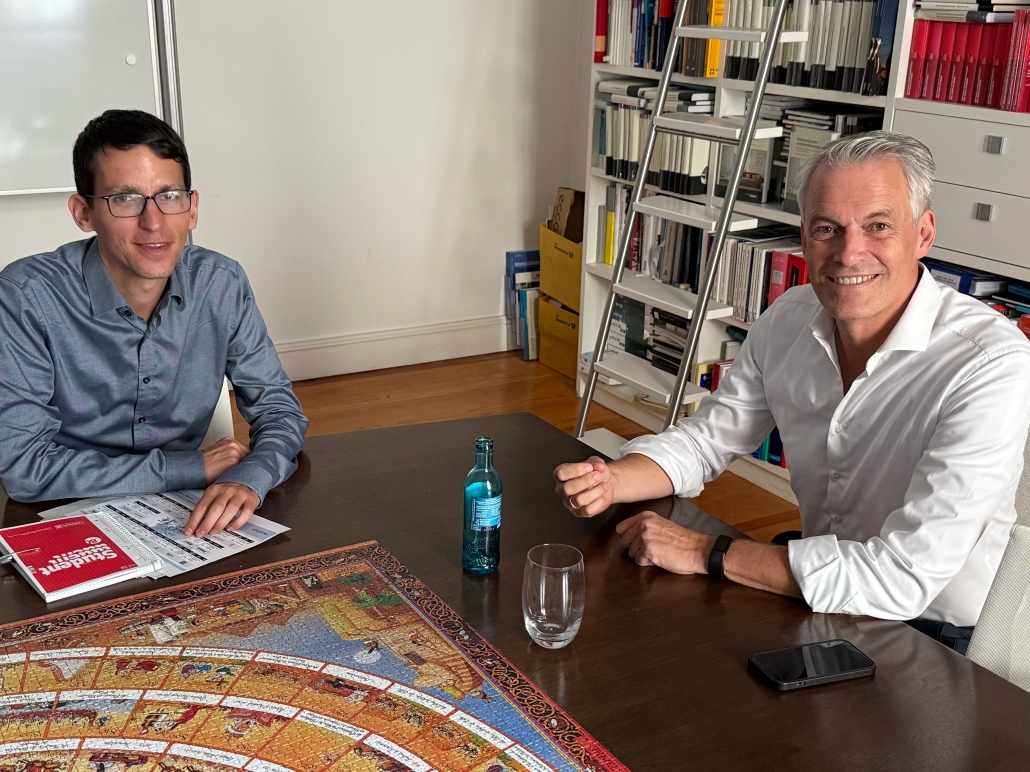
Apleona expects total revenue of around 5 billion euros this year. CEO Jochen Keysberg shared this during a visit to the Immobilien Zeitung newsroom. He credits both strong organic growth and strong inorganic growth for the increase. Since 2022, the facility manager has acquired 20 companies across Europe. These include the German service provider Gegenbauer and the recently acquired Danish company Andersen & Heegaard. Keysberg says more acquisitions will follow soon: “The pipeline is well filled.”
“Organic growth will remain the ‘central driver’ going forward, and our M&A pipeline is also well filled”
According to the latest Lünendonk list, Apleona’s total revenue reached 4.3 billion euros in 2025, with German revenue at 3.2 billion euros. The company has grown remarkably in the decade since it spun off from Bilfinger’s facility services division. The 2017 Lünendonk list put total revenue for 2016 at 2.2 billion euros. German revenue that year stood at 1.4 billion euros. However, those figures still included revenue from Bilfinger Hochbau. That division moved to Implenia in spring 2017. The total also included a contribution from the consulting firm GVA, which was sold to Avison Young in 2018.
Strong Growth Continues
Keysberg attributes the rapid revenue growth mainly to strong organic growth. He stresses that this will remain the “central driver” going forward. He sees the greatest potential for this in the industrial sector. “I have no doubt that we will see more outsourcing in the industrial sector.” Family-owned businesses in particular have often avoided outsourcing so far. Many clients, he says, kept services and staff in-house without applying strategic criteria.
“I have no doubt that we will see more outsourcing in the industrial sector”
Keysberg says the current split is mostly rooted in history. For example, some companies outsourced the maintenance of newly built halls because they didn’t want to hire additional staff for it. Alongside those halls often stand older buildings still maintained by the client’s own employees. Keysberg explains that sometimes tasks get outsourced simply because the employees who used to handle them are retiring. When Apleona takes over a service, staff from the client company often move over to the service provider as well. At the same time, the tough situation facing many industrial companies has ended the era when Apleona employees would quit to take a better-paying job at a client.
The Economy Doesn’t Worry the CEO
Keysberg stresses that Apleona’s business is quite “resilient” to the weak economy. The service provider does maintain individual plants belonging to manufacturers that have announced major layoffs. “If a plant were to close, that would hit us. But that hasn’t happened yet.” Usually, at most a repurposing takes place. And: “Every kind of repurposing creates extra work for us.” That’s because it typically requires rebuilding smaller installations. “Change isn’t a bad thing.”
“Apleona’s business is quite resilient to the weak economy — change isn’t a bad thing, because every kind of repurposing creates extra work for us”
Keysberg says the key is that Apleona doesn’t cross a certain line: “We don’t do industrial services.” In other words, the provider doesn’t handle production equipment directly — only the buildings and their surroundings. He explains that the “scope of service” doesn’t depend on how many shifts run in a given hall. “The building envelope has the same maintenance requirements” regardless. He points to a similar situation in offices during the Covid-19 pandemic: “The offices were empty, but we still carried out the usual maintenance work. That’s why it didn’t cause a substantial downturn.”
Many clients are now weighing what they can save by deploying technology. This covers both their core business and their corporate real estate management. Those responsible for that area, in turn, are approaching service providers. On AI and digitalization, though, Keysberg sees Apleona well positioned. In 2027 the company plans to roll out a single AI work interface group-wide. Among other things, it will let employees operate enterprise resource planning (ERP) and computer-aided facility management (CAFM) programs. The tool targets staff who rarely work with those software solutions and aims to make them easier to use.
A Unified AI Interface Simplifies Daily Work
The AI will have access to most of the knowledge Apleona has gathered. That includes statistics on equipment failures, technical manuals, and pricing for specific services. This will simplify and improve the process of drafting reports. The AI will check data, make suggestions, and flag potential errors. It will also make it easier for technicians to prepare quotes. The idea is that employees can once again focus more on their actual areas of expertise. As Keysberg puts it: “For us, AI doesn’t replace technicians — it helps them go back to being technicians.”
“In-house delivery plays a central role, because quality and efficiency only improve when as many tasks as possible are completed by our own staff in digitized processes”
Two main prerequisites need to be met for the AI interface to work. One is “high system integration.” Long term, the company wants to use the same systems across the entire group, across countries, for areas like ERP and CAFM. Partly because of its acquisitions, Apleona still uses quite different programs for this in some places today.
The second prerequisite, Keysberg says, is a good, reliable data foundation the AI can draw on. Here too, acquisitions and in-house delivery play a central role. That’s because quality and efficiency improve when own staff complete as many tasks as possible in digitized processes. Only then can the company reliably trace where data comes from and how it was handled. “If you have a subcontractor still using paper slips, you don’t have that efficiency,” the CEO says.
Clients Too Passive on Decarbonization
Apleona has collected extensive data on the CO2 emissions of the properties it manages, including more than 100 office buildings. Measured against the Carbon Risk Real Estate Monitor (CRREM) and its associated climate pathway, more than 30% of them count as stranded assets in 2025. Keysberg says clients have so far taken only limited countermeasures. If nothing changes, more than 50% of these properties could count as stranded assets by 2028.
“By 2028, more than 50% of these properties could count as stranded assets”
According to the CEO, many clients have also done little on another front. Germany’s KRITIS umbrella law, and the requirements it places on certain critical-infrastructure companies, offers real potential for the facility management industry. Still, Keysberg expects change to come only slowly. “More tasks will be added within existing contracts. But we won’t see a jump in revenue next year.”
This article originally appeared in German in Immobilien Zeitung (issue IZ 34/2026, August 2026). Author: Florian Hartmüller. Source: immobilienzeitung.de